Whereas journeying via the far reaches of the photo voltaic system, the New Horizons probe picked up a dusty path of icy fragments that will point out that the Kuiper Belt—residence to former planet Pluto and numerous different objects—is means greater than we thought.
New observations from the NASA mission counsel that the huge donut-shaped outer zone of the photo voltaic system, often known as the Kuiper Belt, may prolong billions of miles farther than present estimates. There even is likely to be a second, outer belt altogether, based on a study revealed in The Astrophysical Journal Letters.
New Horizons turned the primary spacecraft to go to Pluto in 2015 and has been exploring the Kuiper Belt in an prolonged mission ever since, zipping via a area full of the frozen leftovers from the early photo voltaic system. The spacecraft’s Venetia Burney Pupil Mud Counter (SDC) instrument has been detecting increased than anticipated ranges of mud. The mud is made up of remnants from violent collisions that happened between objects within the Kuiper Belt.
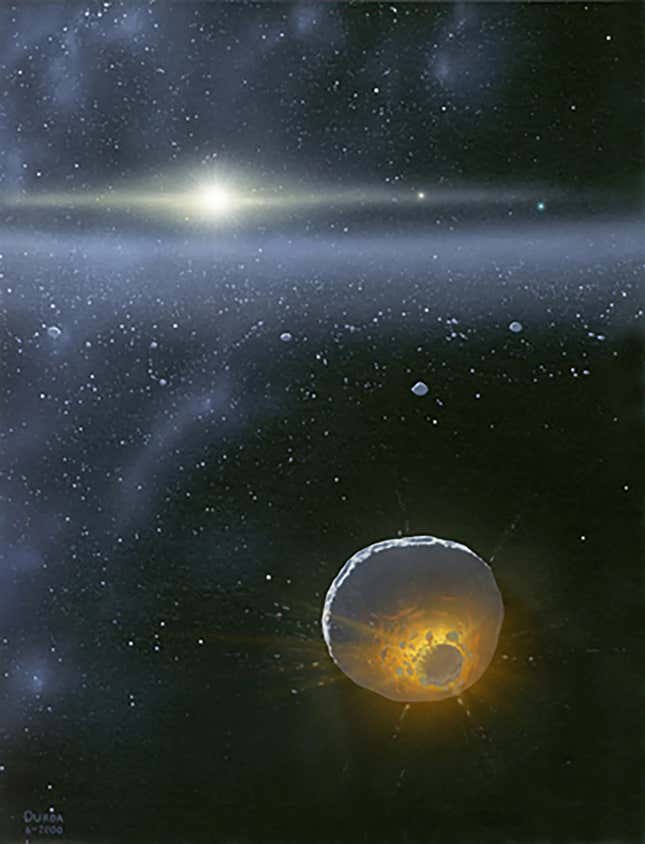
Earlier fashions of the belt present that the quantity of mud ought to begin to decline a billion miles into that distance. The density of mud detected by New Horizons, nonetheless, defies these fashions, suggesting that the Kuiper Belt may prolong a lot farther out than scientists believed. The outer fringe of the belt, the place the density of objects begins to say no, was considered at about 50 astronomical items from the Solar (one AU is the gap between Earth and Solar, about 93 million miles or 140 million kilometers) however new proof suggests the Kuiper Belt could prolong to 80 AU and even past that. The farthest planet from the Solar, Neptune, is situated 30 AU away.
“The concept that we would have detected an prolonged Kuiper Belt — with a complete new inhabitants of objects colliding and producing extra mud – presents one other clue in fixing the mysteries of the photo voltaic system’s most distant areas,” Alex Doner, a physics graduate pupil on the College of Colorado Boulder, and lead creator of the brand new paper, stated in a statement.
The proof introduced by New Horizons can be supported by ground-based observations from the Japanese Subaru Telescope in Hawaii, which found quite a lot of Kuiper Belt objects past what was considered its periphery. Scientists are finishing up extra observations of the belt and searching into different explanations, like a second belt that has not been found but. One other risk is that radiation stress and different elements pushed mud that was created within the internal Kuiper Belt out previous the 50 AU edge.
New Horizons launched on January 18, 2006. The mission was initially presupposed to wrap up in 2024, however NASA recently decided to extend it till the spacecraft exits the Kuiper Belt, which is predicted to happen as early as 2028.
With its new lifeline, New Horizons has loads of time to discover the huge ring of icy objects and one of many largest buildings of the photo voltaic system.
Extra: The Coolest Images Taken by NASA’s New Horizons Spacecraft
Trending Merchandise